Royal Air Force
H is for HawkThe Royal Air Force enters the book through the aircraft watched by Helen’s father as a boy, rather than through an account of the institution’s structure or operations. At Biggin Hill, he photographed aircraft taking off and landing, turning the airfield into a place of sustained observation. The episode makes the service part of a family history organized around looking closely and preserving what might otherwise be lost.
Aircraft as objects of attention
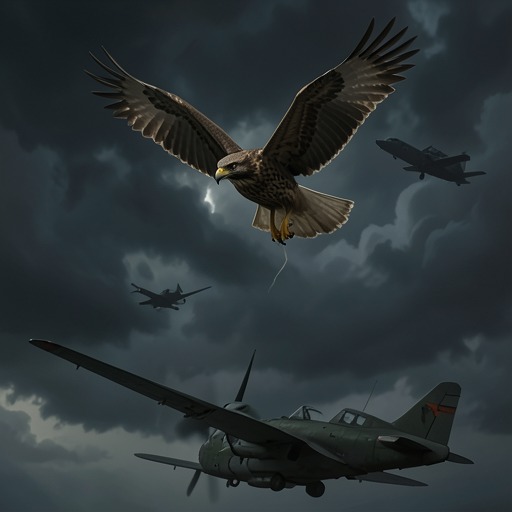
When he was about nine or ten, Helen’s father stood by a fence at Biggin Hill with a Box Brownie camera hanging around his neck. He photographed each aircraft taking off or landing and wrote down its number in a spiral-bound notebook. His attention was methodical: each plane was something to identify, record, and remember. On one visit, an unfamiliar engine note drew his gaze to an aircraft he could not identify from the books he knew. He photographed it and copied its registration number, later understanding it as a new United States Air Force plane.
The Royal Air Force is thus present within a wider practice of aircraft spotting. The account does not describe service personnel or flying operations in detail; it shows the young observer trying to make a record of what passed through the sky. The planes’ movement and the boy’s written and photographic documentation meet in a scene where close attention is itself the central activity.
Observation and restriction
The discovery at Biggin Hill also leads to an abrupt confrontation with security. Guards took the boy to a guardhouse, removed a page from his notebook, and exposed and discarded the film in his camera. They ordered him to go home and forget what he had seen. The account places this intervention at the aerodrome, but does not identify the guards as Royal Air Force personnel. Its significance lies in the contrast between the boy’s impulse to document an unfamiliar aircraft and the demand that he not preserve the encounter.
After the guards sent him away, he stopped crying and tried to recover what he could: he shaded the notebook page with pencil, an attempt to retain the writing after it had been removed. The moment gives his childhood plane-spotting a vulnerable edge. Observation depends on records, but the episode shows that records can be seized or destroyed, and that the observer may be told to forget.
The record carried forward
Years later, Helen finds six of her father’s hardbacked plane-spotting diaries. In 1956, when he was sixteen, he logged aircraft in columns for time, number, type, remarks, and registration number. On one day he watched from 9:40 in the morning until 7 in the evening; the next day’s record runs from 9 in the morning to 9 at night. The diaries range across aircraft types and visits to airports, extending the childhood practice first presented at Biggin Hill into a sustained personal archive.
The Royal Air Force therefore belongs to the book’s account of how her father learned to watch and record the changing sky. His notebooks preserve a form of patient attention that Helen recognizes after his death, when the lists and photographs become more than technical records: they help make his way of seeing accessible to her again.